Last Updated: December 19, 2025
In 1857, Queen Victoria selected a rough lumber town called Ottawa—population barely 5,000—to be the capital of the United Province of Canada, stunning politicians in Toronto, Montreal, and Quebec City who considered their cities far more qualified for the honour.
The decision seemed absurd at the time. Ottawa (recently renamed from “Bytown”) was an isolated frontier settlement dominated by the timber trade, where wooden buildings outnumbered stone structures and sawdust covered muddy streets. Meanwhile, Montreal boasted sophisticated culture and commerce, Toronto wielded economic power, Quebec City held historical prestige, and Kingston offered military significance. Yet Queen Victoria, acting on advice from Governor General Edmund Head, boldly chose the small lumber town—a decision that would prove remarkably astute for reasons both strategic and political. Today, 168 years later, Ottawa stands as the proud capital of Canada, and the wisdom of Victoria’s controversial choice has been thoroughly vindicated.
Key Highlights
TL;DR: Queen Victoria chose Ottawa as Canada’s capital on December 31, 1857, ending decades of political deadlock. The selection was strategic: Ottawa’s isolated location made it defensible from American attack, while its position on the border between English-speaking Canada West and French-speaking Canada East made it a political compromise that favoured neither Toronto nor Montreal. The Rideau Canal provided secure transportation, and the city’s small size reduced risk of political mob violence that had plagued previous capitals.
| Quick Facts | Details |
|---|---|
| 📅 Decision Made | December 31, 1857 |
| 📍 Previous Capitals | Kingston (1841), Montreal (1844), Toronto (1849), Quebec (1855) |
| 🎟️ Population in 1857 | Approximately 5,000 |
| ⏰ Official Designation | February 17, 1858 |
The Capital That Couldn’t Be Decided
For 15 years before Queen Victoria’s intervention, the United Province of Canada lurched from one temporary capital to another in a political dance that satisfied no one. Kingston served first in 1841, then Montreal in 1844, followed by Toronto in 1849, and Quebec City in 1855. The constant moves were expensive, disruptive, and embarrassing for a growing nation trying to establish credibility on the world stage.
The problem was simple: no city could command majority support in the legislature. Each time parliament voted, regional and linguistic rivalries produced deadlock. Toronto represented the economic interests of English-speaking Canada West, but French-speaking Canada East saw it as too Anglo and too Protestant. Montreal was Canada’s commercial heart, but Canada West viewed it as too French and too Catholic. Quebec City had deep historical roots, but lacked economic dynamism and seemed too remote from Upper Canada.
Between 1844 and 1857, the legislature held over 200 votes attempting to settle the capital question. In one particularly convoluted 1856 vote, MPs were given choices between Toronto, Hamilton, Quebec, Montreal, Kingston, and newly renamed Ottawa. Through a blizzard of motions, counter-motions, and political maneuvering, Quebec City emerged victorious by a narrow 64-56 margin. The lower house even voted to allocate 50,000 pounds to construct new legislature buildings.
But the victory was short-lived. The Legislative Council (equivalent to today’s Senate) refused to approve the funding. No funding meant no new buildings, which meant no capital for Quebec City. The political impasse was complete, and the government was essentially paralyzed by its inability to agree on where it should be located.
Exhausted by the endless bickering, the legislature made a desperate decision: they would ask Queen Victoria herself to choose the capital. In 1857, they formally requested that Her Majesty resolve the question that Canadian politicians could not. It was an admission of political failure, but also perhaps the only way forward.
Ottawa: The Unlikely Compromise
When Queen Victoria’s letter arrived on December 31, 1857, announcing Ottawa as the chosen capital, politicians in the established cities were shocked. Ottawa? The lumber town that barely appeared on most maps? The frontier settlement where tavern brawls were more common than cultured conversation?
The Queen’s choice had been heavily influenced by Governor General Edmund Head, who had spent months evaluating the competing cities and their proposals. Head recognized what Canadian politicians could not admit: the capital question wasn’t really about which city was most deserving—it was about which city would be least objectionable to both sides of the linguistic and regional divide.
Ottawa’s greatest qualification was precisely that it wasn’t Toronto, Montreal, or Quebec City. The small settlement sat directly on the border between Canada West and Canada East, its very location a symbol of compromise between English and French populations. Selecting Ottawa didn’t give either side a clear victory, which made it acceptable to both. It was the political equivalent of splitting the difference—choosing neutral ground where neither linguistic community would dominate.
Prince Albert, Queen Victoria’s consort, wrote a memorandum strongly favouring Ottawa. He noted that the city’s location would help unite the two colonies, symbolically and practically bridging the divide that had made governing so difficult. The selection of Ottawa, he argued, would demonstrate that Canada’s future lay in cooperation between its founding peoples, not in the victory of one over the other.
The decision was officially announced on February 17, 1858. Despite significant opposition from disappointed cities, the Queen’s choice was final. For the first time in 17 years, Canada knew definitively where its capital would be.
Strategic and Defensive Advantages
Beyond political compromise, Ottawa offered genuine strategic advantages that made it an astute military choice. In the 1850s, relations between Britain and the United States remained tense, with memories of the War of 1812 still fresh. British military planners worried constantly about the vulnerability of Canadian cities to American invasion.
During the War of 1812, American forces had demonstrated how easily they could threaten Canadian supply lines along the St. Lawrence River, which formed the border between Upper Canada and New York State. Any future conflict would see the same vulnerability repeated. British commanders needed a capital that could be defended, even if American forces controlled the St. Lawrence.
Ottawa’s location addressed these concerns perfectly. The city sat far from the American border, surrounded by dense forest and positioned on a cliff face overlooking the Ottawa River. Any attacking force would need to travel hundreds of kilometres through difficult terrain to reach it. Unlike Montreal, which sat within artillery range of the U.S. border, or Toronto, which was vulnerable to naval attack across Lake Ontario, Ottawa could be defended even in a worst-case scenario.
Just as importantly, Ottawa connected to the rest of Canada through the Rideau Canal—the 202-kilometre waterway built specifically to bypass the vulnerable St. Lawrence. From spring through fall, boats could travel from Ottawa to Kingston on Lake Ontario entirely through British-controlled waters, safe from American interference. The canal had been built at enormous cost precisely to solve this military problem, and selecting Ottawa as the capital made full use of that investment.
By 1854, Ottawa also had year-round railway access through the Bytown and Prescott Railway, which carried passengers, lumber, and supplies regardless of weather. The combination of water and rail transportation meant Ottawa wasn’t nearly as isolated as its opponents claimed—it was actually well-connected to the rest of the province.
The city’s small size also worked in its favour. Previous capitals had experienced politically motivated mob violence, with crowds storming legislature buildings during controversial debates. Montreal had been particularly problematic, with the parliament building actually burned by rioters in 1849 during debates over compensation to victims of the 1837 rebellion. Ottawa’s smaller population meant less risk of large-scale civil disturbances that could threaten the government’s ability to function.
From Bytown to Capital City
The transformation of Ottawa from lumber town to national capital didn’t happen overnight. When Queen Victoria made her selection, Ottawa had perhaps 5,000 residents, most connected to the timber industry. The town’s buildings were primarily wooden structures, many hastily built to house workers. Streets turned to mud in spring and filled with sawdust from the numerous mills lining the Ottawa River. Politicians and bureaucrats who had worked in Toronto, Montreal, and Quebec City looked with horror at the prospect of relocating to what many dismissively called an “Arctic lumber village.”
Yet Ottawa possessed hidden advantages that would serve it well. The city owed its existence to Lieutenant Colonel John By, who had established the settlement in 1826 as the construction base for the Rideau Canal. By had chosen the location specifically because of its excellent transportation links—the confluence of the Ottawa River, the Rideau River, and the canal provided water access in multiple directions. The very same strategic considerations that made the spot ideal for a canal terminus made it suitable for a capital.
The city had been incorporated as “Bytown” in 1850, named after its founder. In 1855, anticipating growth and seeking to shed the rough frontier image, residents voted to rename it “Ottawa” after the river and the Algonquin peoples who had inhabited the valley for centuries. The new name gave the city a dignity that “Bytown” lacked, even if the physical town remained quite rough around the edges.
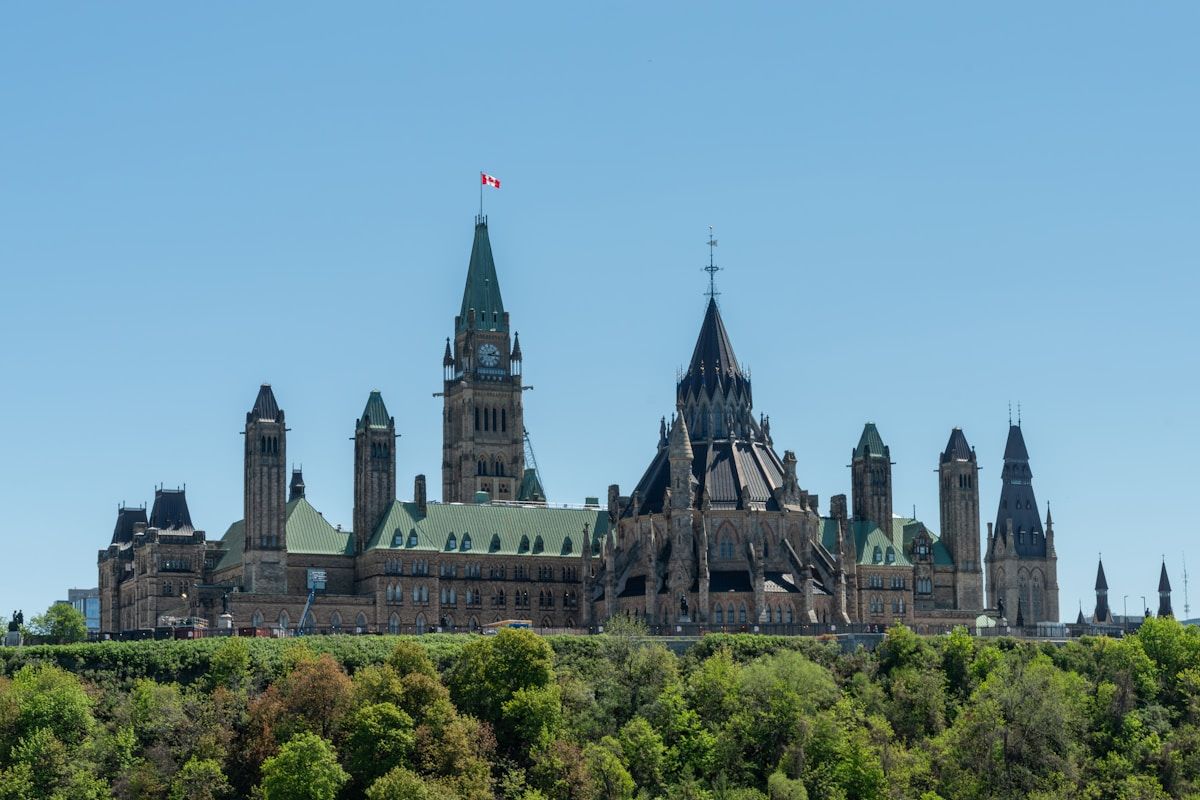
When parliament accepted Queen Victoria’s decision in 1858, Ottawa began its remarkable transformation. Construction of the Parliament Buildings began in 1859 on Barrack Hill (soon to be renamed Parliament Hill), the prominent cliff overlooking the Ottawa River that Colonel By had originally used for military purposes. The Gothic Revival structures that rose over the next decade were deliberately designed to be impressive—to give Ottawa the visual grandeur its opponents claimed it lacked.
The government officially moved to Ottawa in 1866, just months before Confederation created the Dominion of Canada in 1867. What had been chosen as the capital of the United Province of Canada became, almost by default, the capital of the new nation. Ottawa was now the permanent seat of Canadian government, a status it has held for over 155 years.
The Wisdom of Victoria’s Choice
Time has proven Queen Victoria’s controversial decision to be remarkably wise. Ottawa’s position between English and French Canada, which seemed like a political compromise in 1857, became a genuine advantage as the nation developed. The capital’s location has helped it serve as a bridge between linguistic communities rather than being identified with one over the other.
The strategic concerns that motivated the military planners proved unnecessary—Britain and the United States never fought another war, and the Rideau Canal was never used for its intended military purpose. Yet the transportation infrastructure that the canal provided helped Ottawa grow and develop, while the city’s inland position has protected it from some of the economic volatility that affected border and coastal cities.
Perhaps most importantly, Ottawa’s relative smallness in 1857 gave it room to grow into its role without the entrenched political and economic interests that dominated larger cities. Toronto, Montreal, and Quebec City had established elites who would have shaped the capital according to their pre-existing priorities. Ottawa had no such constraints—it could be built from the ground up as a government town, with institutions designed specifically for national rather than regional purposes.
The compromise that seemed like a weakness became a strength. Ottawa’s lack of obvious qualifications meant it had to earn its status as capital through performance rather than presuming it through historical importance or economic power. The city developed a culture focused on government, diplomacy, and national institutions rather than commerce or industry. Today, Ottawa’s identity as Canada’s capital is so thoroughly established that it’s difficult to imagine any other city in the role.
For visitors interested in exploring more of Ottawa’s rich historical heritage, the capital offers countless sites that tell the story of its unlikely rise from lumber town to national capital. The Rideau Canal, now a UNESCO World Heritage Site, remains a powerful symbol of the engineering and strategic thinking that made Ottawa possible. And Parliament Hill itself stands as testament to Queen Victoria’s vision—Gothic towers rising above the Ottawa River, marking the spot where Canadian democracy takes place.
Frequently Asked Questions
Why did Queen Victoria choose Ottawa instead of Toronto or Montreal?
Queen Victoria chose Ottawa primarily because it was the only city that didn’t obviously favour either English-speaking Canada West or French-speaking Canada East. Ottawa sat directly on the border between the two colonies, making it a political compromise that both sides could accept. Additionally, its location far from the American border and its connection via the Rideau Canal made it strategically defensible in case of war.
What was Ottawa like before it became the capital?
Before being chosen as capital, Ottawa (formerly Bytown) was a rough lumber town with approximately 5,000 residents. The economy centred on timber trade, with numerous sawmills along the Ottawa River. Buildings were mostly wooden structures, streets were unpaved, and the town lacked the sophisticated cultural institutions found in Montreal, Toronto, or Quebec City. It was nicknamed an “Arctic lumber village” by skeptical politicians.
Did other cities protest Queen Victoria’s decision?
Yes, politicians from Toronto, Montreal, and Quebec City were shocked and angry at the selection of Ottawa. Many saw it as an insult that such a small, undeveloped town was chosen over their sophisticated cities. However, because the Queen had made the decision at Parliament’s request, there was little they could do to challenge it. The decision was formally accepted in 1858 despite significant opposition.
When did Ottawa officially become the capital of Canada?
Ottawa was selected as capital of the United Province of Canada on December 31, 1857, and officially designated on February 17, 1858. The government moved there in 1866. When Canada achieved Confederation in 1867, creating the Dominion of Canada, Ottawa became the capital of the new nation by default, a status it has held continuously since.
What role did the Rideau Canal play in Ottawa’s selection?
The Rideau Canal was crucial to Ottawa’s selection as capital. Built after the War of 1812 to provide a secure supply route that bypassed the vulnerable St. Lawrence River, the canal demonstrated that Ottawa could be connected to the rest of Canada without passing near American territory. This strategic advantage—the ability to move supplies and troops safely even during wartime—made Ottawa attractive to British military planners who strongly influenced the decision.
Final Thoughts
Queen Victoria’s choice of Ottawa as Canada’s capital in 1857 seemed like political desperation at the time—selecting a frontier lumber town because the real cities couldn’t agree among themselves. Yet what appeared to be a compromise of convenience proved to be strategic brilliance. Ottawa’s position between English and French Canada, its defensible location, and its lack of entrenched interests allowed it to grow into its role as a truly national capital rather than a regional city playing national host.
Today, as you walk through downtown Ottawa, past the Parliament Buildings rising above the Rideau Canal locks, with the Château Laurier’s copper turrets gleaming in the sunlight, it’s hard to imagine the capital being anywhere else. The rough lumber town that shocked politicians in 1857 has become a sophisticated city of nearly one million people, home to national museums, universities, embassies, and cultural institutions that rival any capital in the world. Queen Victoria’s controversial decision, it turns out, was one of the smartest choices in Canadian history. To learn more about the early days of the capital, explore stories about Colonel John By and the founding of Bytown or discover the Bytown Museum, Ottawa’s oldest stone building.
Source: The Historical Society of Ottawa, Britannica - Why Queen Victoria chose Ottawa, History Today - Ottawa chosen as Canadian Capital